
Detection & evals
HELM
Stanford CRFM’s framework for holistic evaluation of language models
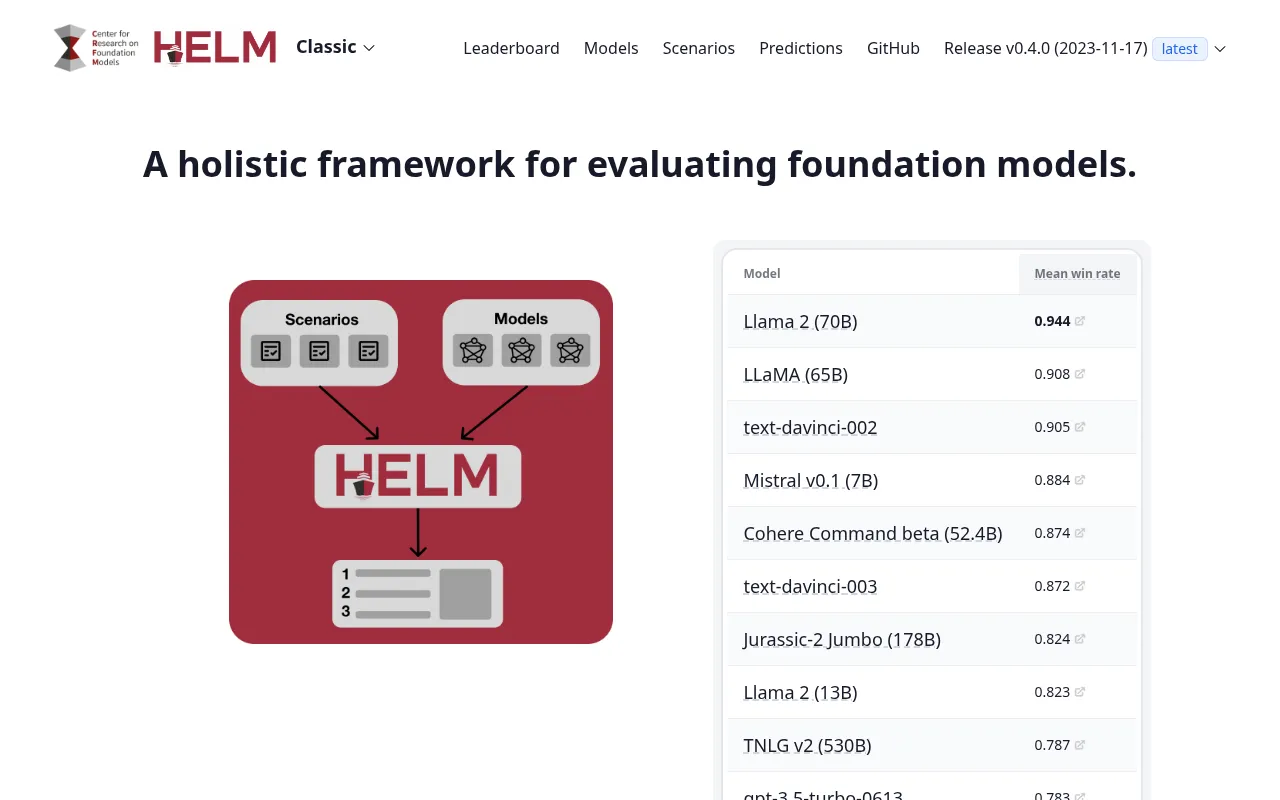
What is HELM?
HELM (Holistic Evaluation of Language Models) is a comprehensive evaluation initiative led by the Center for Research on Foundation Models (CRFM) at Stanford University.The project aims to provide a standardized benchmark that holistically measures the performance of large language models across a wide variety of tasks, scenarios, and metrics, offering transparent and reproducible references for researchers and developers.
As an open-source framework, HELM integrates diverse datasets and evaluation metrics, covering everything from traditional NLP tasks to emerging generative capabilities.It goes beyond simple accuracy to deeply examine model robustness, fairness, and efficiency, helping the community objectively understand the strengths and limitations of different model architectures.
Key features
- Holistic MetricsEvaluates not just accuracy, but also calibration, robustness, fairness, and toxicity across multiple dimensions.
- Standardized BenProvides unified evaluation pipelines and interfaces to ensure scientific and comparable comparisons between different models.
- Broad Task CoverSupports a wide range of mainstream NLP scenarios including question answering, summarization, code generation, and commonsense reasoning.
- Open & TranspareCode and datasets are publicly available, fostering community collaboration and independent verification of evaluation results.
- Multi-Model SuppCapable of accessing and evaluating major open-source and proprietary large language models, with continuously updated model lists.
How to use it
- Visit the official HELM website to view the latest leaderboards and detailed evaluation reports.
- Review the official documentation to understand the list of supported models and specific task definitions.
- Clone the HELM open-source repository from GitHub if you wish to reproduce experiments.
- Configure your local environment and install necessary dependencies to run evaluation scripts.
- Select target models and datasets, execute evaluation commands, and generate result reports.
Where it fits
- Academic ResearcResearchers use HELM benchmarks to compare newly proposed model architectures against existing state-of-the-art models.
- Model SelectionEnterprise developers choose the most suitable foundation models for their business based on evaluation scores for specific tasks like coding or summarization.
- Safety AuditingAssess potential biases or security risks before deployment by analyzing fairness and toxicity metrics.
Pricing and free quota
HELM is an open-source research project; specific usage costs depend on computational resources.Please refer to the official site for details.
Who it is for
- AI Researchers
- LLM Developers
- Data Scientists
- Technical Decision Makers
FAQ
What types of models does HELM primarily evaluate?
HELM primarily evaluates Large Language Models (LLMs), covering both open-source and proprietary mainstream models, with the specific list evolving as the project updates.
Can I run HELM evaluations myself?
Yes, HELM is open-source.You can obtain the code from GitHub and run the evaluation pipeline in your local environment.
What metrics are included in HELM evaluations?
In addition to traditional accuracy and perplexity, it includes holistic metrics such as calibration, robustness, fairness, efficiency, and toxicity.