
AI coding
aiXcoder
Originating from the Software Engineering Institute of Peking University, aiXcoder has been dedicated to intelligent software R&D since 2013.
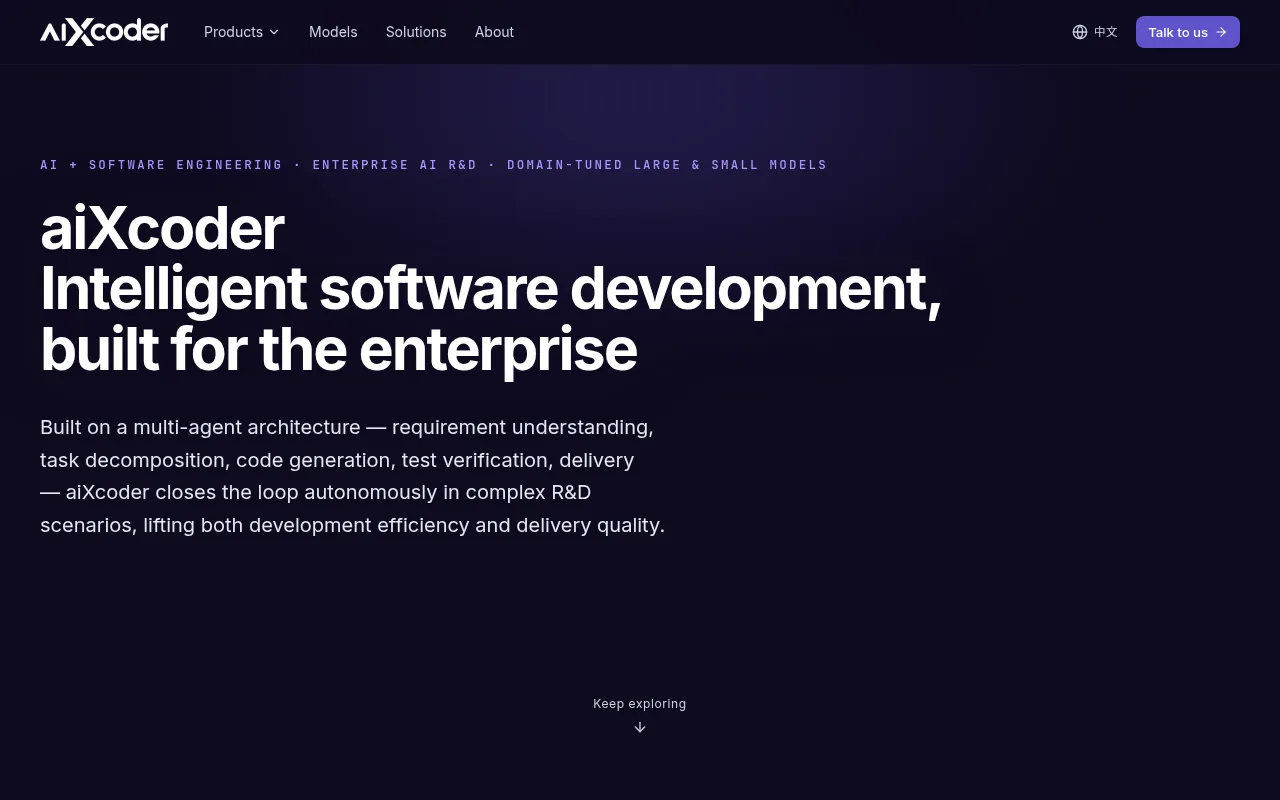
What is aiXcoder?
Originating from the Software Engineering Institute of Peking University, aiXcoder has been dedicated to intelligent software R&D since 2013.As an AI-powered platform based on code large models, it utilizes a multi-agent collaborative architecture to cover the entire lifecycle—from requirement understanding and task breakdown to code generation and testing—enhancing efficiency and delivery quality for enterprise software development.
The platform offers six enterprise-grade code agents and the Enterprise Hub management console, supporting full-stack private deployment.Its core strength lies in the 'Large x Small' model collaboration: large models handle global cognition and complex decisions, while specialized small models (such as the open-source aiXapply-4B) handle high-frequency deterministic tasks.It has achieved large-scale adoption in critical industries including telecommunications, finance, aerospace, and nuclear power.
Key features
- Multi-Agent CollIncludes six agents like Requirement Agent, CodeAgent, and TestAgent, achieving an autonomous loop from requirements to delivery.
- Enterprise Hub CUnified management platform for agents, models, MCP, Skills, prompts, and knowledge bases, enabling centralized configuration and distribution.
- Large & Small MoLarge models act as decision hubs, while specialized small models (e.g., aiXapply-4B) handle high-frequency subtasks, optimizing cost and speed.
- Full-Stack PrivaSupports intranet operation with data sovereignty, adapting to domestic chips and computing resources to meet security compliance needs.
- IDE & CLI IntegrCodeAgent Plugin supports VS Code and JetBrains IDEs; CodeAgent CLI enables natural language dialogue and batch changes in the terminal.
- Math2Code ConverCombines rule engines with large models to accurately convert LaTeX formulas and algorithm specs into engineering code with bidirectional traceability.
How to use it
- Contact official support for requirement assessment and enterprise codebase POC.
- Deploy the Enterprise Hub control platform to configure models, knowledge bases, and agent permissions.
- Install and configure CodeAgent Plugin (VS Code/JetBrains) or CLI within your team's environment.
- Invoke Requirement Agent to clarify needs or use CodeAgent for code generation based on scenarios.
- Use TestAgent to auto-generate test cases and keep project documentation synced via CodeWiki.
Where it fits
- Financial BankinScaled adoption in large banks with millions of lines of code generated and hundreds of thousands of auto-corrections, boosting developer productivity.
- Aerospace AlgoriAutomatically parses algorithm design docs to generate high-reliability C code, supporting critical software for lunar exploration projects.
- Nuclear Power CoFirst domestic nuclear-specific code large model, fully adapted to domestic chips with high compilation pass rates for generated code.
- Telecom TestingEnd-to-end automation from requirements to test scripts, significantly improving test case acceptance rates and script development efficiency.
Pricing and free quota
Pricing and any free quota follow the official site.
Who it is for
- Enterprise R&D teams
- Critical industries like finance and aerospace
- Government and enterprises prioritizing data security
- Software companies requiring domestic hardware adaptation
FAQ
Which IDEs does aiXcoder support?
CodeAgent Plugin covers the two major mainstream IDE families: VS Code and JetBrains.
Does it support private deployment?
Yes, it supports full-stack private deployment, including models, agents, and the Enterprise Hub, ensuring data stays within the intranet.
What are the features of the aiXapply-4B model?
It is a specialized small model for code change application, deployable on a single consumer GPU, with accuracy comparable to hundred-billion parameter models and fast inference.
How can I manage team AI resources?
Use the Enterprise Hub platform to centrally configure and distribute agents, models, knowledge bases, and skills, preventing resource fragmentation.